
EU is taking decisive steps toward digital and technological sovereignty, particularly in the strategic domains of computing infrastructure and advanced microelectronics. At the heart of this effort lies the European Processor Initiative (EPI), which aims to deliver the first EU-designed processor capable of competing globally in performance, energy efficiency, and security. Yet, cutting-edge hardware alone is not enough. To unlock its full potential, it must be supported by a robust, cloud-ready, and open software ecosystem. This is the challenge addressed by the AERO project where its mission is to enable the effective adoption of the EU processor in cloud computing environments by developing and optimizing a comprehensive open-source software stack, fully aligned with the processor’s architecture. By ensuring that software evolves at the same pace as hardware, AERO helps establish a coherent EU cloud platform that can rival existing mainstream solutions, which are currently dominated by non-EU providers. In doing so, the project directly contributes to strengthening European data sovereignty and reducing technological dependencies.
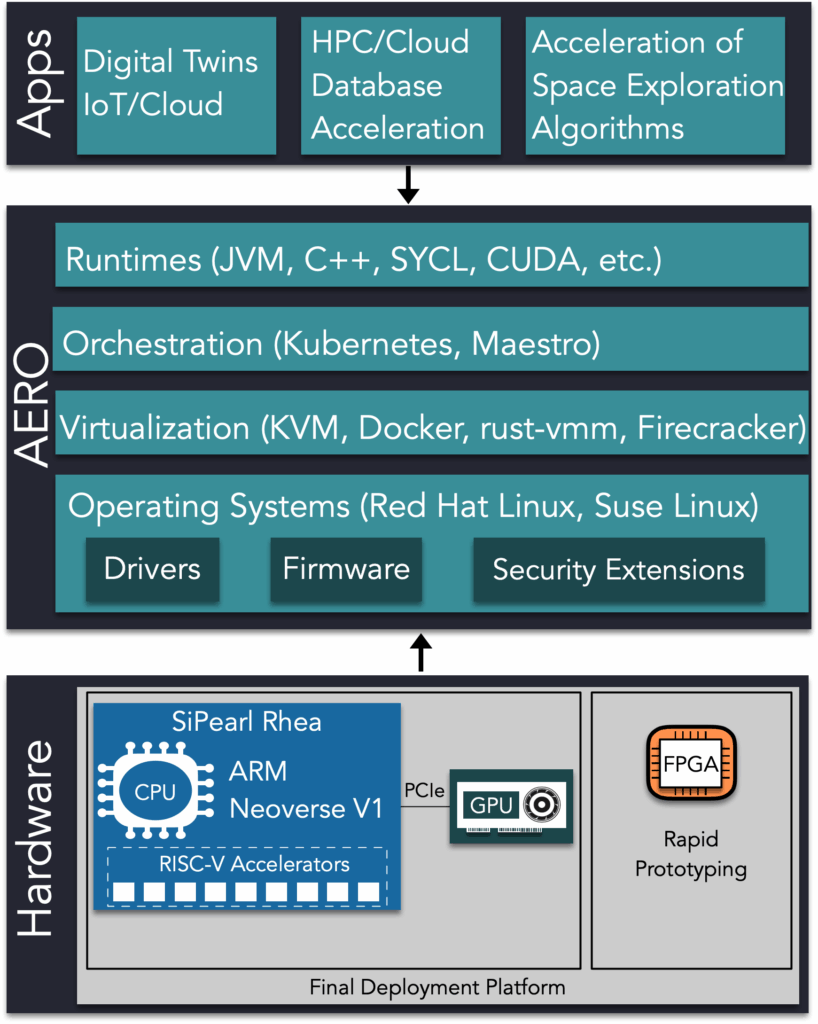
The AERO software ecosystem spans the full cloud computing stack. It includes operating systems, compilers, runtimes, system software, and auxiliary deployment and management services. These components are enhanced with novel software–hardware interfaces designed to seamlessly exploit the heterogeneous nature of the EU processor. This approach allows cloud workloads to benefit from high performance, improved energy efficiency, and built-in security features, while remaining compatible with established cloud development and deployment practices. A strong emphasis is placed on open-source development, ensuring transparency, interoperability, and long-term sustainability. By contributing improvements upstream and building on widely adopted technologies, AERO lowers barriers for developers, cloud providers, and industrial users who wish to experiment with or migrate to EU-based cloud infrastructures. This openness is key to fostering a vibrant European ecosystem around the EU processor, extending well beyond the project’s lifetime. AERO also focuses on ease of migration for existing cloud customers. One of its core objectives is to enable organizations to transition their workloads to EU processor-based infrastructures with minimal effort, avoiding costly rewrites or vendor lock-in. By aligning with common cloud frameworks, virtualization technologies and orchestration tools, the project ensures that familiar workflows can be retained while benefiting from EU hardware innovation.
To demonstrate tangible value and encourage early adoption, AERO validates its solutions through industrial pilot use cases drawn from strategically important European sectors, including automotive and space exploration. These use cases showcase how real-world cloud workloads can be deployed on EU processor-powered infrastructures, highlighting both technical feasibility and business potential.
Within this broader framework, ITML plays a key role in maximizing the impact and long-term value of AERO’s results by leading dissemination, communication, exploitation, and standardization activities, ensuring that the project’s outcomes reach the right audiences and translate into sustainable uptake. ITML focuses on defining exploitation pathways, aligning AERO results with relevant standards, and strengthening links with industry and innovation ecosystems, thereby supporting the transition from research to real-world adoption.
In summary, AERO is a pivotal initiative for EU’s cloud future. By bridging advanced processor technology with a mature, open and cloud-ready software ecosystem, and by actively supporting exploitation and standardization, AERO helps lay the foundations for a competitive, secure, and sovereign European cloud infrastructure, one that can endure well beyond the project itself and deliver lasting value to EU industry and society.